Since 1984
The history of Abagold
From a shoreline once abundant with perlemoen to South Africa's first commercial abalone farm — the story of Abagold is the story of Hermanus itself.
Hermanus
A town built on abalone
When Hermanus was founded more than 150 years ago, perlemoen — abalone — lay abundant on the shoreline. The fishing industry was the first economic base of the town, and became its first tourist attraction as well. Over the years the bounty of fish was aggressively harvested, many species disappeared, and attention turned to the prized shellfish: abalone.
Regulations, limited quotas and a cap on the number of packers in the industry could not safeguard the resource. Poachers discovered the easy money available, and poaching grew into a full-scale industry.
The Turning Point
The case for aquaculture
Fortunately, there were people of vision in the early 1990s, when the abalone poaching problem was still in its infancy. It was clear that government could not do enough to protect the wild resource — and that the only possible solution was aquaculture.
The pressure on the wild fishery was stark. In 1993 the industry was removing 600 tons a year, sport divers an estimated further 150 to 200 tons, and poachers around 200 tons — the resource was only just keeping up with its harvesters. In the years that followed, despite a total ban on sport diving and the complete closure of the commercial harvest, poaching continued to strip an estimated 1,000 tons a year, leaving the wild population in severe danger of depletion.
In the early 1990s, attempts began to do on land what Mother Nature seems to do so effortlessly at sea. Research into the spawning and rearing of abalone was in its infancy, but visionaries like Dr Pierre Hugo of Abagold — prepared to invest time, money and expertise — turned these ventures into a viable farming business.
The Abagold Timeline
Four decades in the making
Milestones on the journey from experimental breeding work to a farm supplying the world.
1984
First experiments
The late Pierre Hugo begins experimental work on abalone breeding — at a time when no established methods existed for breeding abalone in captivity.
1991
Pilot hatchery at the Old Harbour
A pilot hatchery is established at the Old Harbour in Hermanus, focused on developing controlled, repeatable systems suited to on-land farming.
1992
Abagold is established
Abagold is formally established on South Africa's Atlantic coast as the country's first commercial abalone farm, developing on-land, tank-based systems fed by cold Atlantic seawater.
1995
Abagold Limited
The company is registered as Abagold Limited (Reg. No: 1995/070041/06).
2006
A processing facility of our own
Abagold commissions its own state-of-the-art canning and processing facility, which becomes the quality benchmark for canned and dried abalone from South Africa.
2017–2021
Resilience through adversity
From Red Tide in 2017 to Covid in 2020 and 2021, the people and spirit of Abagold endure the toughest of times — and through resilience and fortitude, the company again emerges on top.
Today
Supplying the world
More than four decades after that first experimental work, Abagold farms abalone on land in Hermanus and supplies live abalone and a range of abalone products to international markets.
Haliotis midae
The prized shellfish
Abalone — from the Spanish abulón — are marine snails of the family Haliotidae, a single genus counting roughly 100 to 130 recognised species worldwide. They are known by many names: ear-shells, sea-ears, muttonfish in Australia, ormer in Jersey and Guernsey, paua in New Zealand — and perlemoen in South Africa.
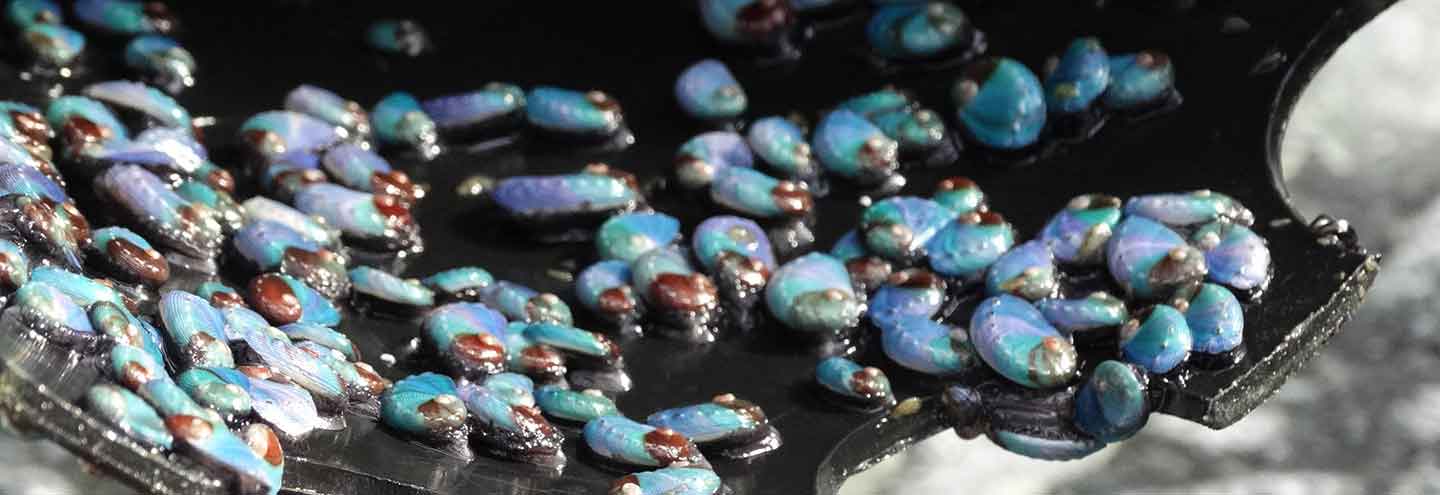
Their shells form a low, open spiral, marked by a row of respiratory holes near the outer edge. The innermost layer is composed of nacre — mother-of-pearl — which in many species is highly iridescent, giving rise to strong, changeable colours that have made the shells prized as objects of beauty. The flesh of the large abalone is considered among the world's most desirable foods.
Haliotis midae, the species Abagold farms, is unique to the South African coastline — revered around the world, and at home in the cold Atlantic waters of Hermanus.
The result of four decades
The patience of forty years, in every shell. Discover abalone raised where the story began.
Contact our export team